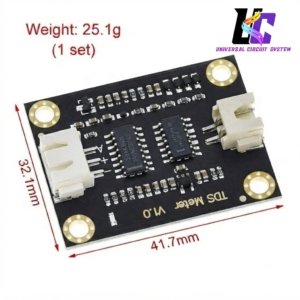
Gravity: Analog TDS Sensor / Meter for Arduino.


Roll over image to zoom in
৳ 1,880.00৳ 2,100.00 (-10%)
The Gravity: Analog TDS Sensor / Meter for Arduino is a compact, plug-and-play water quality kit designed to measure the Total Dissolved Solids (TDS) level in liquids. Operating between 3.3V and 5.5V, it is fully compatible with Arduino, ESP32, and Raspberry Pi microcontrollers, providing a stable 0–2.3V analog output that represents water purity from 0 to 1000 ppm.
The kit features an anti-polarization AC excitation source that extends the life of the included waterproof probe, making it an ideal choice for smart water testing, hydroponics, aquariums, and water filtration monitoring.
Would you like help with any of the following?
See the exact connection wiring diagram for your microcontrollerLearn how to add temperature compensation for more accurate ppm readingsGet a list of typical TDS values for drinking water, tap water, and RO water
Gravity: Analog TDS Sensor / Meter for Arduino.
The Gravity: Analog TDS Sensor / Meter Kit for Arduino is a highly effective, plug-and-play solution designed to evaluate the Total Dissolved Solids (TDS) levels in liquids. This hardware setup lets makers, students, and engineers quickly measure water cleanliness and track real-time purity values across a wide variety of smart environmental projects.

Gravity: Analog TDS Sensor / Meter for Arduino.
🌟 Key Product Features
- Wide Voltage Range: Fully supports input power ranging from 3.3V to 5.5V DC, making the module natively compatible with standard 5V controllers (like Arduino Uno/Mega) as well as modern 3.3V control architectures (such as ESP32, Raspberry Pi Pico, and STM32).
- Anti-Polarization Probe Design: The signal conditioning transmitter board utilizes an AC excitation source for data acquisition. By toggling alternative current signals across the pins, the system actively minimizes electrical polarization at the probe tips. This drastically enhances output stability and protects the physical needles from long-term corrosion or calcification.
- Submersible Waterproof Probe: The package includes a heavy-duty, two-needle waterproof probe capable of remaining fully submerged for reliable long-term water metrics.
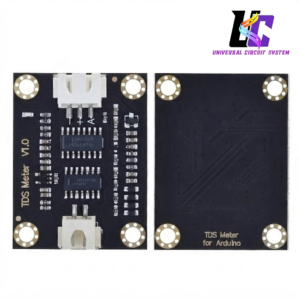
- Seamless Interface: Features an onboard Gravity standard layout (PH2.0-3P interface) alongside an intuitive color-coded cable assembly, ensuring clean, solder-free wiring setups.
Gravity: Analog TDS Sensor / Meter for Arduino.
🛠️ Common Applications
- Domestic Drinking Water Monitoring: Ideal for benchmarking pure tap water against industrial filtration systems like Reverse Osmosis (RO).
- Hydroponics & Indoor Farming: Used by growers to audit nutrient chemical density dissolved in water tanks.
- Aquariums & Aquaculture Ecosystems: Keeps delicate aquatic habitats within precise mineral concentration limits.
- Environmental Field Testing: Deployed on remote IoT field devices to sample river water or open lakes.
📊 Technical Detailed Specifications
| Technical Parameters | Rated Values |
|---|---|
| Input (Supply) Voltage Range | 3.3V ~ 5.5V DC |
| Output Signal Voltage | 0V ~ 2.3V Analog |
| Operational Working Current | 3mA ~ 6mA |
| TDS Active Measurement Range | 0 ~ 1000 ppm |
| Measurement Resolution/Accuracy | ±10% Full Scale (at 25°C) |
| Signal Board Physical Size | 42mm × 32mm |
| Cable Length (TDS Probe) | Approximately 83 cm |
| Hardware Interfaces Included | PH2.0-3P (Gravity Module) / XH2.54-2P (Electrode) |
Gravity: Analog TDS Sensor / Meter for Arduino.
⚠️ Implementation Considerations & Cautions
- Waterproof Limitations: Only the probe head and cable are waterproof; the connector and signal transmitter board are not waterproof and must be protected from spills and moisture [DFRobot Technical Documentation].
- Temperature Limits: The probe is not rated for use in liquids exceeding 55°C, as high thermal conditions can degrade materials and skew calculations [DFRobot Technical Documentation].
- Container Placement: Avoid placing the probe directly against the edges of your testing container, as container boundaries can distort electrical paths and affect reading accuracy [DFRobot Technical Documentation].
Would you like assistance with any of the following steps?
*
*
A step-by-step calibration procedure to fix inaccurate ppm readings
A wiring guide to use this module safely with a 3.3V ESP32 or ESP8266 board
Mathematical formulas to convert the raw analog voltage into a precise PPM value manually


Reviews
There are no reviews yet.