
NRF24L01+PA+LNA Wireless Transceiver Module with SMA Antenna 2.4GHz
Roll over image to zoom in
৳ 300.00৳ 350.00 (-14%)
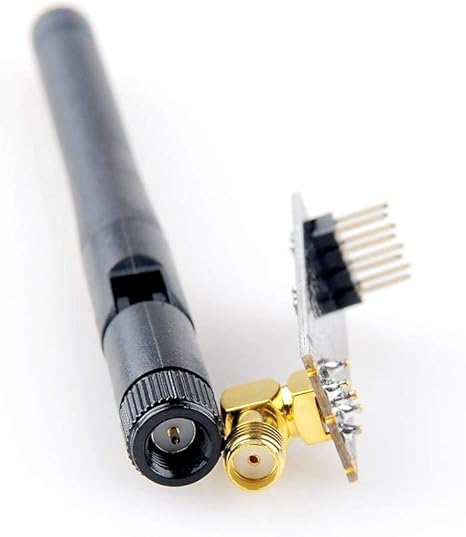
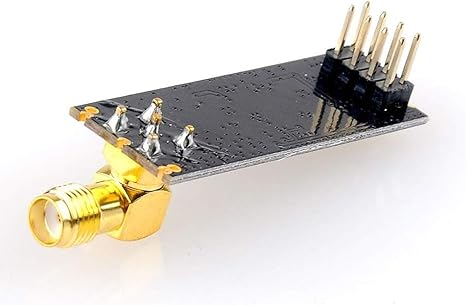
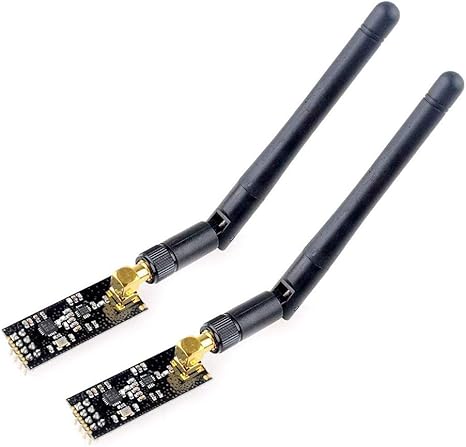
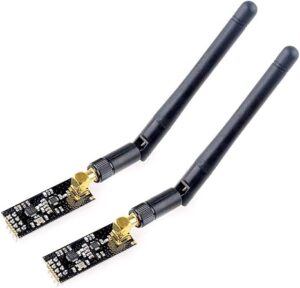
The NRF24L01+PA+LNA Wireless Transceiver Module is a long-range, high-performance 2.4 GHz RF communication board designed for microcontrollers [context]. Operating on an optimized 3.3V DC supply, this advanced module integrates an onboard Power Amplifier (PA) and a Low Noise Amplifier (LNA) to break through interference and extend data transmission up to 1100 meters [context]. Communicating over a standard SPI interface, it features an ultra-compact black-mask PCB layout, a pre-soldered gold-plated SMA antenna connector, and a detachable high-gain 2.4G omnidirectional antenna—making it an essential component for long-range Arduino robotics, wireless telemetry, and remote mesh networking.
Product Overview
The NRF24L01+PA+LNA Wireless Transceiver Module is a long-range, high-performance 2.4 GHz RF communication board engineered to provide ultra-reliable wireless data linking between microcontrollers [context]. Operating over the globally license-free ISM band, this advanced module takes the industry-standard Nordic nRF24L01+ architecture and amplifies it for demanding industrial and outdoor environments. It acts as a powerful wireless data pipe, letting development platforms like Arduino, Raspberry Pi, STM32, and ESP32 exchange complex data, telemetry, and control packets across massive physical distances without lagging or dropped connections.
Advanced RF Amplification & Antenna System
While a standard NRF24L01+ module with an onboard trace antenna is limited to short indoor distances (around 100 meters), this high-power variant expands performance via a specialized dual-amplifier layout [context]:
- Integrated Power Amplifier (PA): Boosts the raw electrical strength of the outgoing 2.4 GHz radio frequency signal, maximizing transmission power so the data stream can travel much farther and slice through dense environmental obstacles [context].
- Low Noise Amplifier (LNA): Functions as an ultra-sensitive electronic ear. It isolates and amplifies extremely weak incoming radio waves from distant transmitters while filtering out background electronic noise, drastically boosting packet recovery rates.
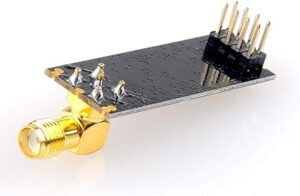
- Gold-Plated Female SMA Connector: The board terminates in a heavy-duty, edge-mounted SubMiniature version A (SMA) coaxial socket [context]. The gold plating minimizes insertion losses and signal reflections, ensuring maximum power transfers cleanly out to the antenna [context].
- Detachable 2.4G Omnidirectional Antenna: Includes a high-gain, rubber-ducky style omnidirectional antenna [context]. The articulating hinge design allows users to fold and position the antenna at a 90-degree or straight angle to match their specific product enclosure layout.
Technical & Communication Specifications
- Extreme 1100-Meter Range: Achieves an open-air line-of-sight communication range of up to 1100 meters (approx. 3600 feet) when configured at its lower data rate with optimized power routing [context].
- High-Speed SPI Data Interface: Communicates with host microcontrollers via a standard 4-wire Serial Peripheral Interface (SPI) clock lane, matching high-speed data execution requirements effortlessly.
- Multi-Channel & Multi-Point Grid: Supports up to 125 independent communication channels, allowing multiple separate wireless networks to operate in the same area without cross-talk. It also features 6-channel data pipe multi-receiving capabilities.
- Configurable Data Transfer Speeds: Software settings allow builders to tune data rates dynamically between 250kbps, 1Mbps, and 2Mbps to balance extreme range against raw bandwidth throughput.
Hardware Interface Pinout (2×4 Header Layout)
The module breaks out all necessary logic lines using a compact, dual-row 8-pin male header:
GND: System common ground link.VCC: 3.3V DC Dedicated Power Input. (Note: This module draws high current peaks during transmission; connecting it directly to a weak 3.3V pin on an Arduino Uno without an external smoothing capacitor can cause stability drops).CE(Chip Enable): Sets the module into active RX (Receive) or TX (Transmit) modes.CSN(Chip Select Not): Low-logic SPI communication select line.SCK(Serial Clock): Synchronizes data bit timing across the SPI bus.MOSI(Master Out Slave In): Accepts incoming data settings from the microcontroller.MISO(Master In Slave Out): Feeds received wireless data back to the host microcontroller.IRQ(Interrupt Request): An active-low signal pin that alerts the host microcontroller the exact millisecond a new packet arrives, eliminating the need for inefficient code-polling loops.
Common Engineering Applications
- Long-Range Remote Control Systems: Crafting custom high-reliability radio transmitters and receivers for RC airplanes, heavy-duty industrial drones, and autonomous agricultural rovers.
- Wireless Mesh Sensor Networks: Dispersing long-range environmental tracking modules across farms, factories, or forests to report real-time temperature, moisture, and security data back to a central hub.
- Smart Home & Industrial Telemetry: Linking remote water tank monitors, off-grid solar arrays, and detached garage gates directly to a central home automation console across large properties.
- Autonomous Robotics Platforms: Providing constant, low-latency telemetry updates and manual safety-override streams for rolling rovers and mapping equipment working deep in the field.


Reviews
There are no reviews yet.